Myasishchev M-50: The Soviet Bomber That Bombed
Maybe the Tu-95 Bear lives on, but not this aircraft.

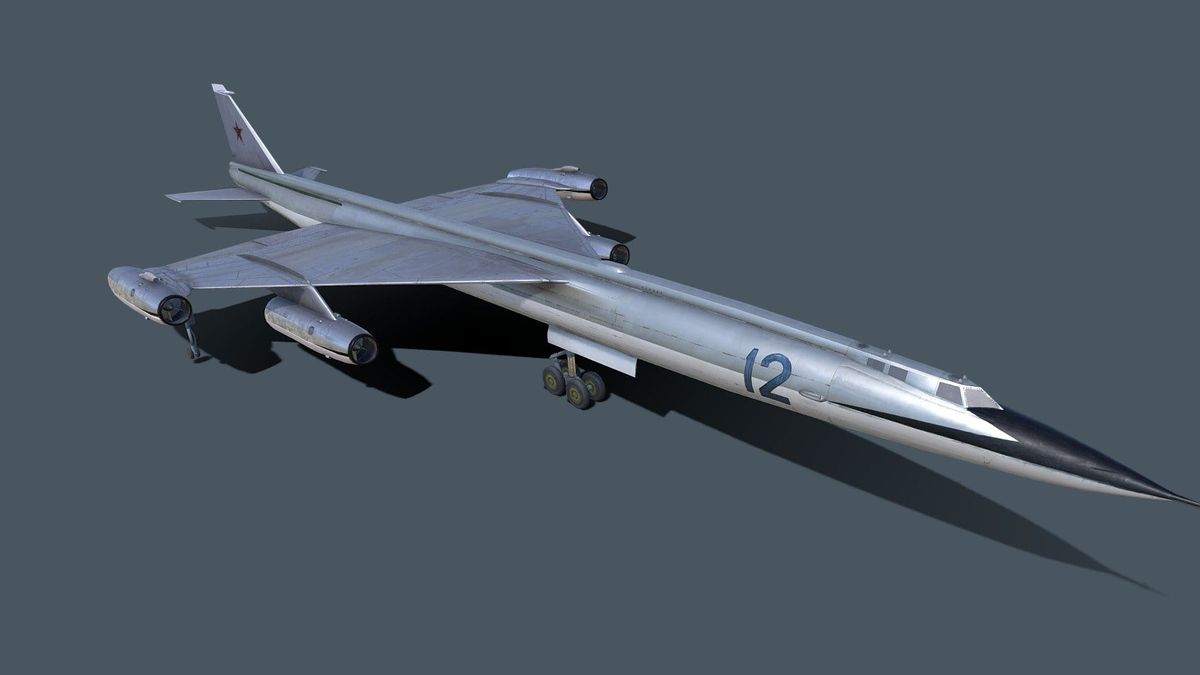
When you say that a bomber bombed, it would be like saying a vacuum cleaner sucks. The phrase can be interpreted in two ways, both of which have complete opposite meanings. Today, we will discuss the Myasishchev M-50, which was built to rival the fateful North American XB-70 Valkyrie, even though that bomber was (to a lesser extent) a failure as well.
During the arms race of the Cold War, the Soviets tried to outperform (at the very least, match) anything the Americans could build, and by now, they learned that the Americans were developing a next generation, supersonic bomber, this being the Convair B-58 Hustler, capable of speeds over Mach 2. The Soviets had heard about the B-58 through their spy network and responded by giving the task of building a worthy competitor to the V. M. Myasishchev Experimental Design Bureau, or OKB-23 (Opytno-Konstruktorskoye Byuro-23). In 1955, under the direction of Georgi Nazarov and with assistance from the TsAGI (Central Aerohydrodynamic Institute), the bureau came up with several designs which were evaluated and tested in a wind tunnel. Some of these designs included an aircraft that would launch from the underside of another aircraft, similar to the North American X-15. Another design was a plane that could take off and land on water. But the design which was able to meet the performance goals and was possible to build was selected. This new aircraft would be designated the Myasishchev M-50.
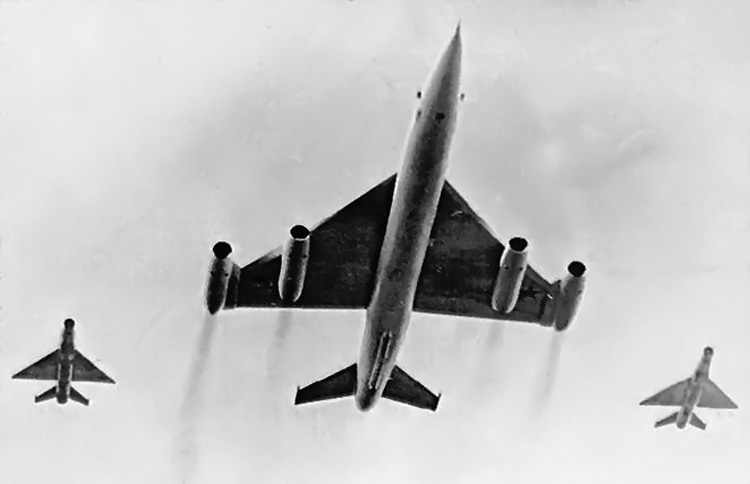
This design resembled a scaled-up Mikoyan-Gurevich MiG-21, comprising a large, slender fuselage with a large delta wing in the middle. And like the MiG-21, the M-50's wings were thin and didn't house any fuel. But unlike the MiG-21, the M-50 had four engines, including two on its wingtips. It's also worth noting that the landing gear was in a bicycle formation, meaning a four-wheel setup was located fore and aft of the bomb bay, with two outrigger gears on each wingtip to balance the aircraft. The aircraft would measure 57.48 meters (118 ft 7 in) long with a 25.1-meter (82 ft 4 in) wingspan and a height of 8.25 meters (27 ft 1 in). Its empty weight was 78,860 kg (173,855 lbs.) and its maximum weight was 145,000 kg (319,650 lbs.). Its forecasted performance ceiling was 14,000 meters (45,930 ft), a range of 13,000 km (8,075 miles), a payload of 5,000 kg (11,000 lbs), and a top speed of 1,950 km/h (1,210 mph), or Mach 1.84. New construction methods were required for the new aircraft as well, including the use of a special kind of steel called 30KhGSNA and V-95 light alloy.
Construction of the new M-50 would begin in April of 1956, and it was originally going to have four Zubets RD-16-17 afterburning turbojet engines, which produced 181.32 kilonewtons (40,765 lbs) of thrust each. But construction outpaced engine development, so instead, four non-afterburning Dobrynin VD-7BA engines were temporarily installed before the aircraft was unveiled in July of 1958. Each of these engines produced 95.61 kilonewtons (24,495 lbs) of thrust, a 40% decrease in power. The aircraft was redesignated the M-50A because of the engine change. Even though it seemed free of major problems, its engines couldn't combine the large thrust that the aircraft needed with low fuel consumption.
In October of 1958, the M-50A was disassembled and moved to the Zhukovskiy flight test center. There, it underwent taxi tests which showed that further modifications were needed. After the modifications were put into place, the M-50A took its first flight on October 27, 1959. Initial flight tests progressed rapidly, but the M-50A was damaged in a ground accident on May 12, 1960. During an engine run-up, the M-50A jumped its wheel chocks and collided with a parked Myasishchev 3ME prototype bomber, which was scrapped because of the damage it received. The M-50A was repaired and flying again after two months. For the time being, it seemed like the M-50 (codenamed "Bounder" by NATO) was the Soviet's answer. But it would soon be obvious that this wasn't the case.
By April of 1961, the two inner VD-7BA engines were replaced with afterburning VD-7AM engines, each producing 156.91 kilonewtons (35,275 lbs) of thrust. Slightly derated VD-7BA engines were also installed on the wingtip mounts, as well as new rearward retracting outrigger gears, which increased the wingspan by 10 meters (32 ft 10 in) to 35.1 meters (115 ft 2 in). Flight tests continued, though the M-50A could no longer fly at supersonic speeds due to underpowered engines being in place. The M-50A's range also fell to 9,600 km (5,965 miles), which was 3,400 km (2,110 miles) short of expectations. During this time, the M-50A was painted with different, meaningless radio call numbers to confuse Western observers.
Now it's July 9, 1961, the Soviet Air Force Day, and spectators, including some NATO officials, watching the military air parade at Tushino Airfield in Moscow are in awe of several new aircraft, like the Tupolev Tu-22, nicknamed "Blinder" by NATO. Among other aircraft, and the space capsule of cosmonaut Yuri Gagarin, the Myasishchev M-50A bomber was unveiled for the first time. Escorted by two Mikoyan-Gurevich MiG-21 fighter-interceptors, the M-50A and MiG-21s flew over the crowd, and in an aerobatic maneuver, left its MiG-21 escorts behind and performed a roll. What the spectators didn't realize, however, is that the Myasishchev M-50A would never be seen in the air again, after being flown 18 times prior to this, its first and last public presentation.
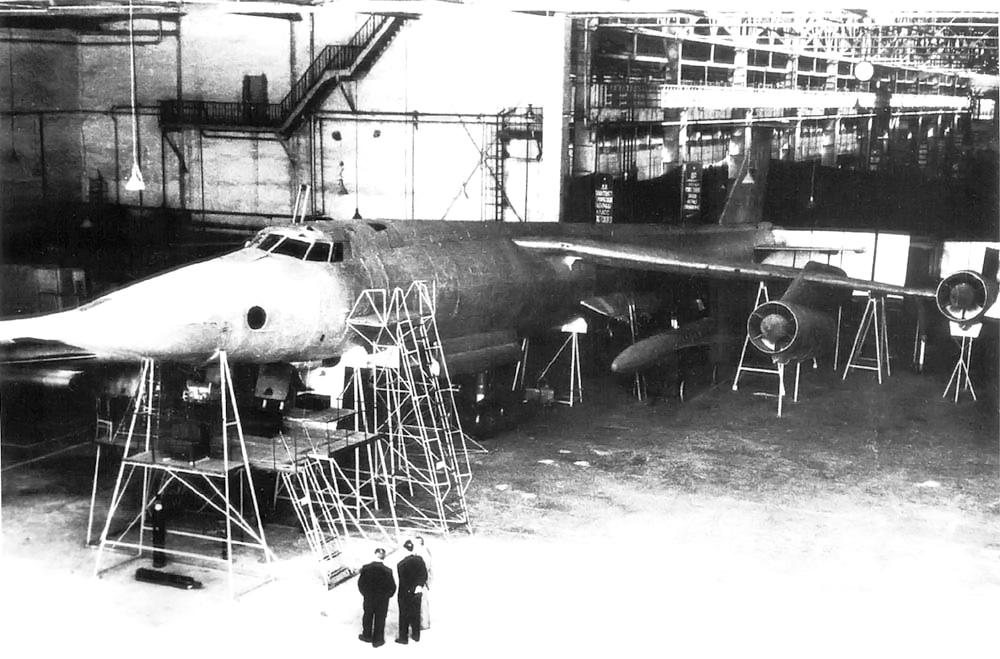
The M-52, a further development of the M-50A, had been under construction since November of 1958. This aircraft kept the four Zubets RD-16-17 engines from before, and the wingtip engines were mounted on larger extensions. The M-52 also had side-by-side seating for the pilot and co-pilot, with a third crew member stationed in the nose. A small, triangular-shaped horizontal surface was added to the top of the vertical stabilizer. Planned upgrades for the M-52 included twin tail guns and attachments that would have allowed cruise missiles to be put on each side of the fuselage, under the wings.
In the end, the M-50A and M-52 were technical successes. But the Soviet premier, Nikita Khrushchev, had other plans. Like the Americans, the Soviets decided to focus on intercontinental ballistic missiles (ICBMs), seeing those as more effective and less expensive than heavy bombers. Because of the subsequent reforms, the Myasishchev M-50A and M-52 planes were canceled, and the OKB-23 was shut down, with its personnel being put to work in an ICBM organization. The M-50A and the M-52, which was almost complete, ended up at Ramenskoye Airport in Zhukovsky, outside of Moscow. In 1968, the M-50A was put on display at the Central Air Force in Monino Airfield, also near Moscow, where it still sits today. The M-52 was scrapped in the 1970s.
Do you think this bomber could’ve worked? Leave a comment!
Sources: Found and Explained, War History, Old Machine Press
 MSW
MSW
 William Pearce