When a Nazi Pilot Helped a Damaged American Bomber
Even during war, some come to their senses during battle.

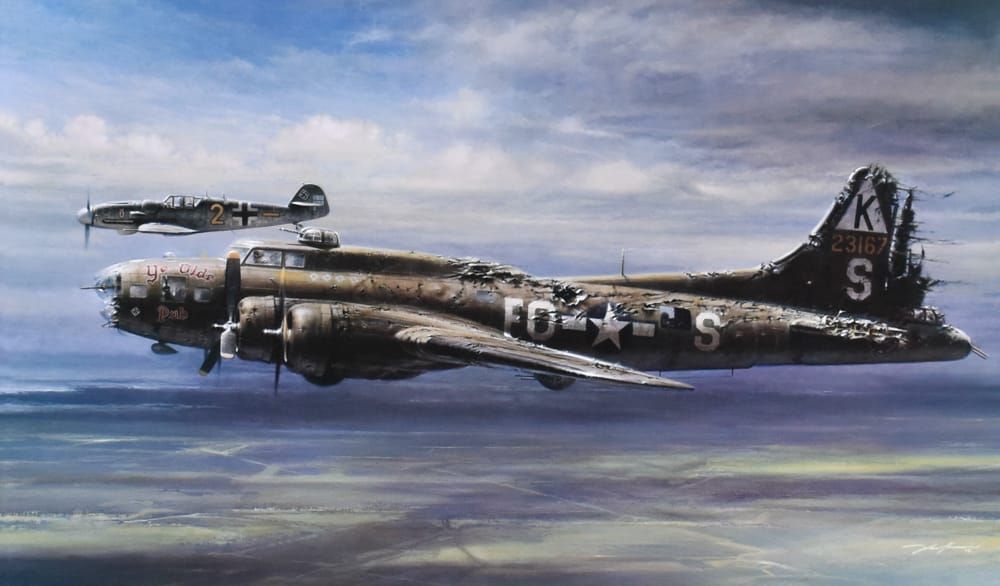
It’s easy to forget that during wartime, not everyone wants to kill the enemy. This is especially true of the 2022 Russian invasion of Ukraine and was the case during the 1914 Christmas truce in the First World War, but it was also true during the Second World War. Even though Germany’s Wehrmacht war machine had been brainwashed by anti-Semitic propaganda, at least one Nazi pilot managed to reclaim his humanity and helped an Allied bomber. The pilot could have easily shot down the bomber, and the war might have gone differently if not for the Nazi pilot's actions. Today, we will be looking at how a Wehrmacht pilot secretly didn't fire upon an American bomber flying over Germany.
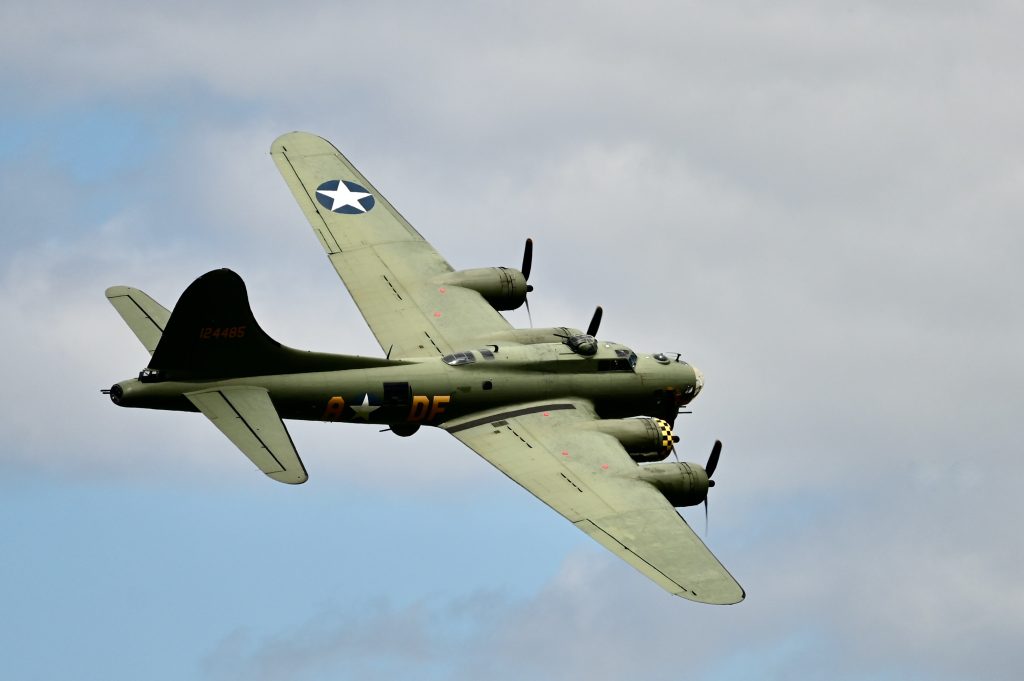
The date is December 20, 1943. The Second World War is nearing its highest point. Europe is being ravaged by the war, with Nazi Germany fighting on two fronts, the Eastern, against the Soviets, and the Western, against the British and Americans, among other Allied countries. Over the North Sea, an American Boeing B-17 Flying Fortress nicknamed "Ye Olde Pub" is flying 20,000 feet (6,096 meters) overhead as part of an 8 mile (12.87 km) long stream of bombers flying towards northern Germany, in search of the Focke-Wulf aircraft factory in Bremen. At the controls of the B-17 is 21-year-old Charlie Brown (not the Peanuts character). Brown is responsible for the lives of 10 young men of the 379th Bombardment Group, and the 10 others are readying twelve 500-pound (227 kg) bombs.
Not long after 11 am, they cross into enemy territory. Though they are escorted by a group of Republic P-47 Thunderbolts who will intercept enemy fighters, German anti-aircraft weapons could easily bring down Allied aircraft, and the crew know it. At 11:30 am, tufts of black smoke began to appear over the ground. German 88mm Flak anti-aircraft guns are being fired at the American planes. Each shell weighs around 20 pounds (9 kg), and each has a differently timed fuse, making them detonate at different altitudes. These explosions rock the Ye Olde Pub, and seeing through the smoke is now nearly impossible. Right in front of the aircraft, a red flash exploded. The glass nose of the Ye Olde Pub is blown off, and even though the men at the front of the aircraft aren't hurt, a frigid -60°C (-76°C) wind now blows throughout the aircraft. On top of that, another red flash exploded outside the aircraft, killing engine number two. Then another shell detonates, traveling through the left wing before exploding above the Ye Olde Pub. Engine number four is now damaged and spinning out of control.
By now, Brown is fighting the controls to keep the damaged wing from tearing off. But then another shell shreds through the roof. Brown is now fighting to keep the plane flying straight forward when the order to drop the bombs comes over the plane's radio. The plane's cargo is unleashed on the burned city below. After this order was completed, it was time to return to base. The formation of the planes that survived head towards the North Sea. But they're still over enemy lines.
The crew of the Ye Olde Pub search the horizon for more enemy fighters. There aren't any. But that doesn't take away from the fact that Ye Olde and another bomber are the only ones still flying out of the squadron, and both bombers are severely damaged. The second bomber dives in an attempt to put out a fire on board. It disappears behind some clouds when another red flash goes off. The second bomber is gone. On top of this, another wave of Focke-Wulf Fw 190 fighters has just appeared on the horizon. There is another problem. A squadron of Messerschmitt Bf 109s has just come up, through the clouds where the second B-17 was shot down. The Ye Olde Pub's men ready their machine guns, while the Fw 190s aim at the Ye Olde Pub's cockpit in an effort to take out the pilots and flight controls in the same attack. Brown turns the plane directly towards the Fw 190s, giving them an extremely narrow time frame to shoot at the Ye Olde Pub. The attackers are caught off-guard, and their bullets miss the cockpit and bounce off the Ye Olde Pub's roof. The Ye Olde Pub's machine gunner fires at an Fw 190. It catches on fire and descends. The Ye Olde Pub's nose gunner fires at another Fw 190 in an effort to avoid a collision. The Ye Olde Pub still has a fighting spirit left.
The Bf 109s close in from behind. The tail gunner of the Ye Olde Pub tries to turn to fire at them, but to no avail, as the winds have frozen the oil on the guns. The Bf 109s are in hot pursuit. The tail gunner signals Brown, who banks the Ye Olde Pub into a steep bank. The Bf 109s fire at the Ye Olde Pub, penetrating the ball turret and cut off half the rudder.
The radio operator calls for help, but only static is received, as bullets have pierced the radio. On top of this, 20mm shells have penetrated the aircraft and severely wounded many crew members. The tail gunner is dead, and the living crew members are now affected by the freezing outside winds. Brown is now fighting to keep the Ye Olde Pub airborne. Only one of the machine guns is now operable. Another attack hits the cockpit, puncturing Brown's oxygen tank. The bomber tips to the left and is now spiraling out of control. Now low on air, Brown tries to gain control, but it is now nearly impossible since the rudder is damaged. With the Ye Olde Pub upside down, Brown's vision is fading.
The bomber is now plunging towards the city of Oldenburg; Brown realizes that the lower altitude has more oxygen. Brown grips the controls to try and stabilize the plane, which is now around an altitude of 3,000 ft (914 m) and is still descending rapidly. Brown pulls the plane out of a dive right over the houses of Oldenburg, nearly close enough to some to shear off the roof shingles. Brown pulls the plane up, but most of the crew is dead or unconscious.
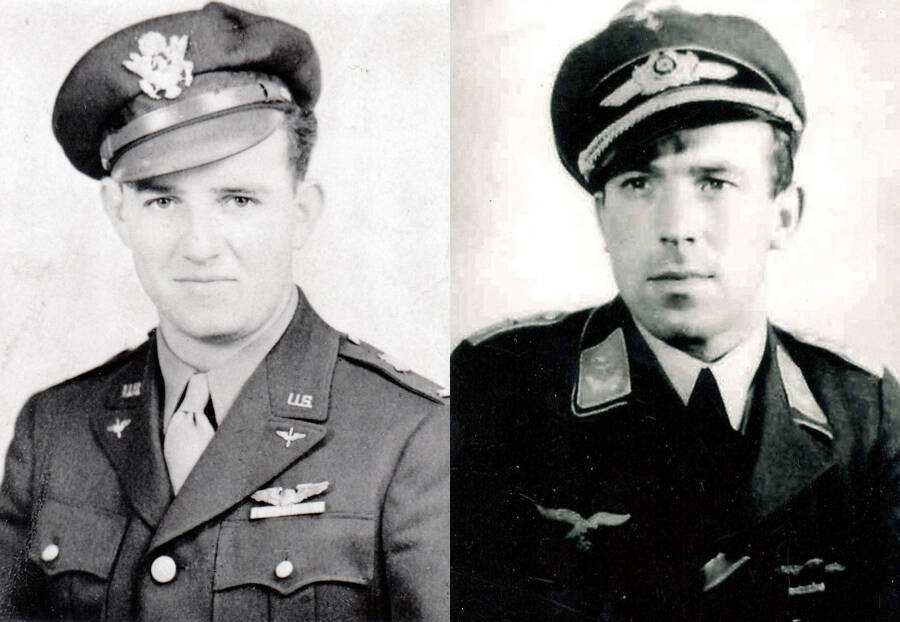
Now only able to fly at 135 mph (217 km/h) back to England, they will need to fly through the German Atlantic Wall again, something the remaining crew dreads. Brown gives them the option of jumping out of the plane, on the basis that being a prisoner of war is preferable to being shot up, but the crew refuse. Soon enough, they fly over Jever airfield, where a German pilot by the name of Franz Stigler is readying the engine of his Messerschmitt Bf 109.
The previous day, Stigler had brought down two B-17s, and shooting down another would make him eligible for the Knight's Cross of the Iron Cross. And seeing cities like Hamburg and Bremen being reduced to rubble in his native Germany didn't necessarily make Stigler angrier at the Allies, but it did fuel his jingoistic ambitions to serve his country. Stigler had actually served in the Libyan desert, where he lost a brother in the Afrika Korps. As Stigler closed in on the Ye Olde Pub, with his finger close to the trigger, something stops him.
Since the Ye Olde Pub isn't firing at him, Stigler goes in to investigate some. Now, he sees the damage that the Ye Olde Pub has suffered. Flying alongside the B-17 by now, he is stunned that the aircraft is still flying, considering the hardships it has just been put through. The only gun that isn't destroyed on the Ye Olde Pub is the ball turret, but the gunner is dead and the guns are frozen over. Stigler figures (correctly) that only a few shots from his guns would seal the Ye Olde Pub's fate but also knows that there's no real glory in shooting down a plane this damaged.
Brown is scanning the horizon for Flak-Guns when he sees Stigler in the Bf 109 right next to the Ye Olde Pub. The two men can actually see one another from inside their respective cockpits. Stigler waves and points down, trying to get Brown to land, because Stigler knows that there is no way the B-17 can survive crossing the Atlantic Wall. Brown responds by shaking his head. This presents a choice to Stigler: shoot them down and return home or help them.
As they approach the Atlantic Wall, Stigler has made up his mind. Help the enemy B-17. The trained eyes of the German anti-aircraft gunners recognize the Bf 109 as one of their own. and not a single one of them opens fire on the B-17. Stigler himself would spend the rest of his life wondering what the anti-aircraft gunners thought at the sight they saw that day. The B-17 and Bf 109 fly by without being fired upon, and Brown still has no idea what has just happened. He only realizes it when Stigler salutes him and banks away.
Ye Olde Pub makes it back to England, but, needless to say, not in one piece. In fact, making a smooth landing at all is a miracle. The commanding officer is about to award the remaining crew medals for their service, but the High Command hears about what has just happened. And they're mad. No one can know about what has taken place. As such, the entire thing is kept under wraps. Stigler would land back in Bremen but cannot tell anyone about what he has just done. At the very least, he could get court-martialed. At the worst, he could be executed.
This tale would fade away until 1985, 42 years later, when Boeing invites fighter pilots to the 50th anniversary of the B-17, since its first flights were in 1935. By this point, Stigler was living in Vancouver, Canada, and was the only German pilot in attendance. At the same time, a local TV station had interviewed him, and he told his story. That same year, Brown wrote to the original German flying ace, Adolf Galland, and the German magazine Jagerblatt, to find out who saved him on the day of the incident.
Beginning in 1986, Stigler began to search for the pilot he had assisted during that day. After a 4-year long search, Brown and Stigler met for the first time in 1990, 47 years after the incident. A friend of Brown's brought along a video camera to capture the meeting. In the video, Stigler became emotional and explained that, after meeting Brown, he said "I love you, Charlie." Brown himself recounted that his nightmares had ended, and he began to feel at peace. At a later date, Stigler was invited to a banquet with the crew he had saved. The crew's children and grandchildren were also in attendance. On another later date, Stigler had also given Brown a book with an inscription inside, saying "In 1940, I lost my only brother as a night-fighter. On December 20, 1943, four days before Christmas, I was able to save a B-17 from its destruction. The pilot, Charlie Brown, is as precious for me as my brother was. Thanks Charlie. Your brother, Franz." Stigler and Brown would remain close friends until Stigler died in Vancouver on March 22, 2008, at the age of 92. Brown would die on November 24 of that year in Miami, Florida, at the age of 86.
What would you have done in this situation? Leave a comment!
Sources: Sabaton.net, Human Defense Initiative
 Nathan Apodaca