That Time Zambia Tried to Go to Mars
An African country on Mars? The thought occurred to one of them...

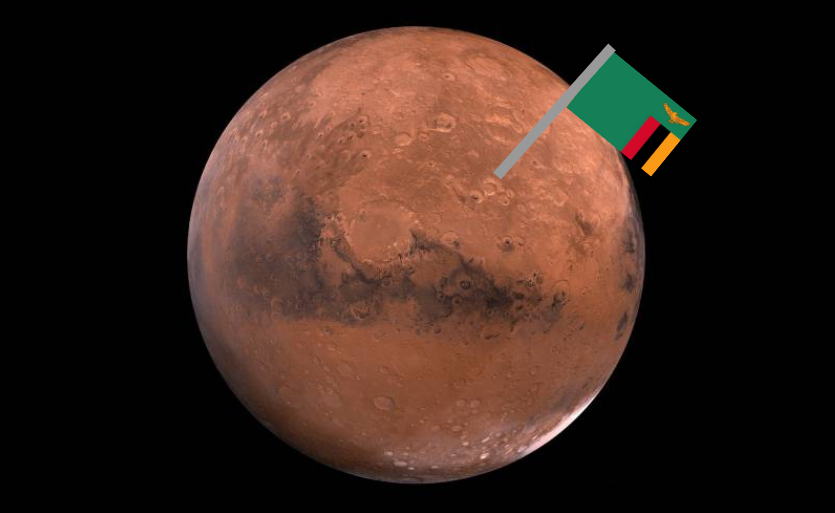
When one thinks of the Space Race, the two countries that many think of are the United States and the Soviet Union. One country that certainly doesn’t come to mind (and one that many have forgotten exists) is Zambia, a country in southern Africa. The year is 1964, and the two superpowers are hard at work trying to outpace the other in space technology. And some countries are bound to get caught up in all that. Zambia had gained its independence from Great Britain on October 24th of that year and had recently changed its name from the British protectorate of Northern Rhodesia. And they apparently thought they were obligated to beat the two superpowers in the Space Race.
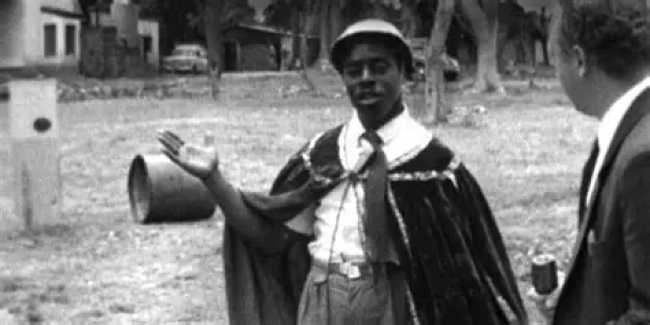
Time magazine had published an article in November of 1964 on the new nation's first president, Kenneth David Kaunda, who was described as a "preacher's son and ex-schoolteacher" who advocated for "positive neutrality" in the Cold War, as well as "multiracial society" in Zambia. Another figure, mentioned at the end of the article, would soon make a name for himself in the following months and years, this being a grade-school science teacher and the self-appointed Zambian Director of the unofficial National Academy of Science, Space Research, and Philosophy, Edward Makuka Nkoloso. Nkoloso had told reporters, who had ensued after catching wind of the last paragraph of Time magazine's article, "some people think I'm crazy. But I'll be laughing the day I plant Zambia's flag on the moon," which did very little to clarify whether or not his efforts were serious or not. It's also worth noting that Nkoloso wore a standard-issue combat helmet, a khaki military uniform, and a cape with an embroidered neck. As silly as this sounds, Nkoloso had actually planned out what would happen had any of his efforts been remotely serious. Another tidbit of information worth noting is that Nkoloso said he was inspired to travel to the moon after his first airplane flight, when the pilot refused to stop the plane so that Nkoloso could get out and walk on the clouds.
Nkoloso first had ambitions for the moon. He had assigned then-21-year-old Godfrey Mwango with the moon landing. He then recruited twelve individuals and put them through training that he had devised. These participants would later be known as "Afronauts," a term coined by Nkoloso. Even Nkoloso's dog, Cyclops, was also recruited to be a space dog, reminiscent of Laika of the Soviet Union. The other recruits involved were told to carry a Zambian flag and a staff in the shape of "a crested eagle on a dinner plate atop a sawn-off broomstick." Nkoloso also had even more ambitious plans to land on Mars. He wanted to establish a Christian ministry to the “primitive” Martians, for which he was sending a 16-year-old “space girl” named Matha Mwamba, two specially trained cats, and a missionary to Mars. But he gracefully warned the missionary not to force Christianity on the people of Mars if they didn’t want it.
Several sources at the time said that Nkoloso requested an amount of money between $20 million and $2 billion from the US, Israel, the Soviet Union, the United Arab Republic (a short-lived union between Egypt and Syria), and even UNESCO. All of these requests were never responded to by any official government or organization, although Nkoloso did receive "piles of letters from foreign well-wishers containing plenty of advice, but no money aside from a 10-rupee note from an Indian schoolboy." Despite all of this, Nkoloso insisted on keeping his space program's details a secret, saying "you cannot trust anyone with a project of this magnitude. Some of our ideas are way ahead of the Americans and the Russians and these days I will not let anyone see my rocket plans." Even though Nkoloso said this, he still invited reporters inside his makeshift headquarters, which changed locations according to his day job. One thing that Nkoloso demonstrated to the reporters was his way of training the Afronauts how to handle the weightlessness of the moon and re-entry, doing so by rolling the recruits down a hill inside a 40-gallon oil drum. One British reporter said, "to most Zambians, these people are just a bunch of crackpots, and from what I've seen today, I'm inclined to agree."
As if it needed to be said, the Zambian space program (if you could call it that) never really took off. And things began to fall apart pretty quickly for Nkoloso. In August of 1965, Nkoloso told the A.P. "my spacemen thought they were film stars. They demanded payment. Two of my best men went on a drinking spree a month ago and haven't been seen since... Another of my astronauts has joined a local tribal sing and dance group." Nkoloso, even from the start, was complaining that "[the recruits] won't concentrate on space flight. There's too much love making when they should be studying the moon." Matha Mwamba, now 17, eventually became pregnant, and was taken away by her parents.
His hopes were shattered when the US landed on the Moon in 1969, and the Afronauts left the program out of despair. Nkoloso was sure that the success of this program would prove to be an important step in making Zambia the "Controllers of the Seventh Heaven of Interstellar Space" and would show the world that Zambians were inferior to no one in space technology, even though he never had any credible evidence to back this up. Nkoloso would go on to drift through a number of sinecures before going to law school at the University of Zambia, and the degree he earned in 1983 didn't yield any better circumstances for him. A year later, he was working as a security officer for an industrial development company outside of Lusaka, the capital of Zambia. In one of his final interviews, he said "it is too low for me, and I don't want to talk about it." When Nkoloso died on March 4, 1989, his space dreams diminished and got buried with him. But Nkoloso saw a huge dream in situations where people fight for basic necessities and tried his best to make it a reality. And to this very day, Nkoloso is an inspiration to the Zambian people, even though his name still comes up in written works such as "Never in a Million Years: A History of Hopeless Predictions" by Ivor Baddiel and Jonny Zucker, and "Dumb History: The Stupidest Mistakes Ever Made" by Joey Green.
Do you think an African country could land on another planet one day? Leave a comment!
Sources: Open Culture, The New Yorker, Griot Magazine
 Colin Marshall
 Namwali Serpell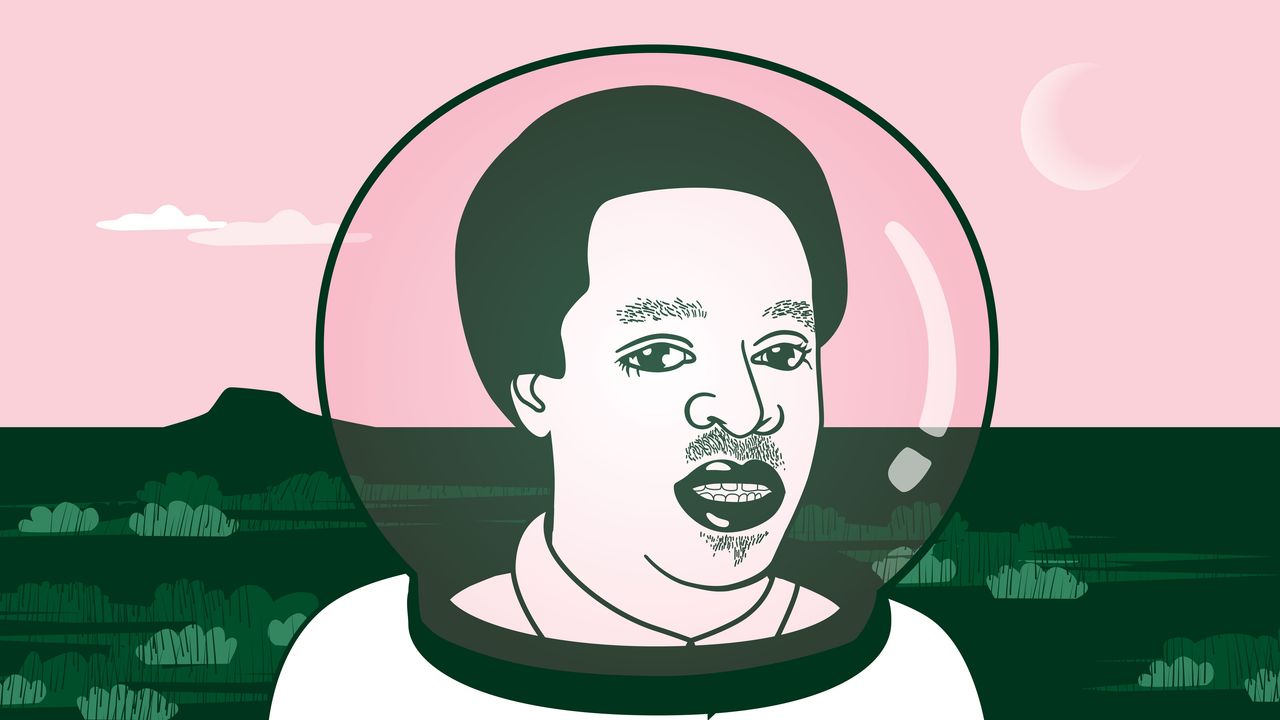
 Eric Otieno Sumba